What is an electronic security survey?
An electronic security survey, in the Netherlands called an Elektronisch Veiligheidsonderzoek (EVO) and internationally a TSCM sweep, is a technical counter-espionage examination of a room or object for planted eavesdropping and observation devices. An EVO combines examination of the radio spectrum with physical inspection, cable measurement and thermal, optical and acoustic measurements. The result is a report recording what was examined, what was found and where the limits of the examination lie.
Why is an EVO needed?
Eavesdropping is not a theoretical risk. At companies, governments and international institutions, eavesdropping devices are found in furniture, fittings, ventilation, cabling, computer systems and peripherals.
Observation equipment is evidently hard to recognise, and the period between placement and discovery (dwell time) is usually months. Detection almost never happens by chance, but through targeted examination. The strictly methodical GreyOps approach is designed to reliably detect and interpret eavesdropping devices and unwanted signals that are present.
State secrets are not the only thing worth eavesdropping on. A boardroom regularly carries information that is worth money to a counterparty straight away: an acquisition file, the lower limit in a negotiation, reorganisation plans that are still confidential, the line of reasoning in ongoing litigation, tender amounts, R&D representing years of investment. Information that is well protected elsewhere, but is discussed out loud here.
The actor behind an eavesdropping device is therefore not necessarily an intelligence service. In the documented cases, alongside state actors, the parties involved are competitors, a contracted security company and an internal team. The means are widely available: a recorder or a microphone with a SIM card costs tens of euros and requires no technical knowledge to place. What is needed, brief physical access, is rarely scarce in a meeting room: cleaning, maintenance, IT, catering and external visitors all pass through, and the room stands empty for most of the day.
The consideration for a sweep is therefore not only a high threat level, but also specific conversations, processes or use of rooms. Consider what a subject is worth to the parties with an interest in it. Whether equipment has been placed cannot be established without an examination. A carefully placed eavesdropping device usually leaves few visible traces. The consequences often come to light only after confidential information has already been compromised.
What we look at and why
Examining the radio spectrum
Most eavesdropping devices send what they pick up (audio and video) over radio. A key part of a sweep is therefore the systematic examination of the radio-frequency spectrum. Using broadband receivers and spectrum analysis, we look for signals that do not belong there: GSM, Wi-Fi, Bluetooth and newer methods such as BLE and Wi-Fi HaLow. Transmitters that work in short bursts or spread their power across a wide range are harder to find. That calls for the right measurement equipment as well as interpretation of the results.
Timing matters. Equipment that is switched on and off remotely is often activated selectively (during office hours, for example). For intensively used rooms, we therefore measure at various times.
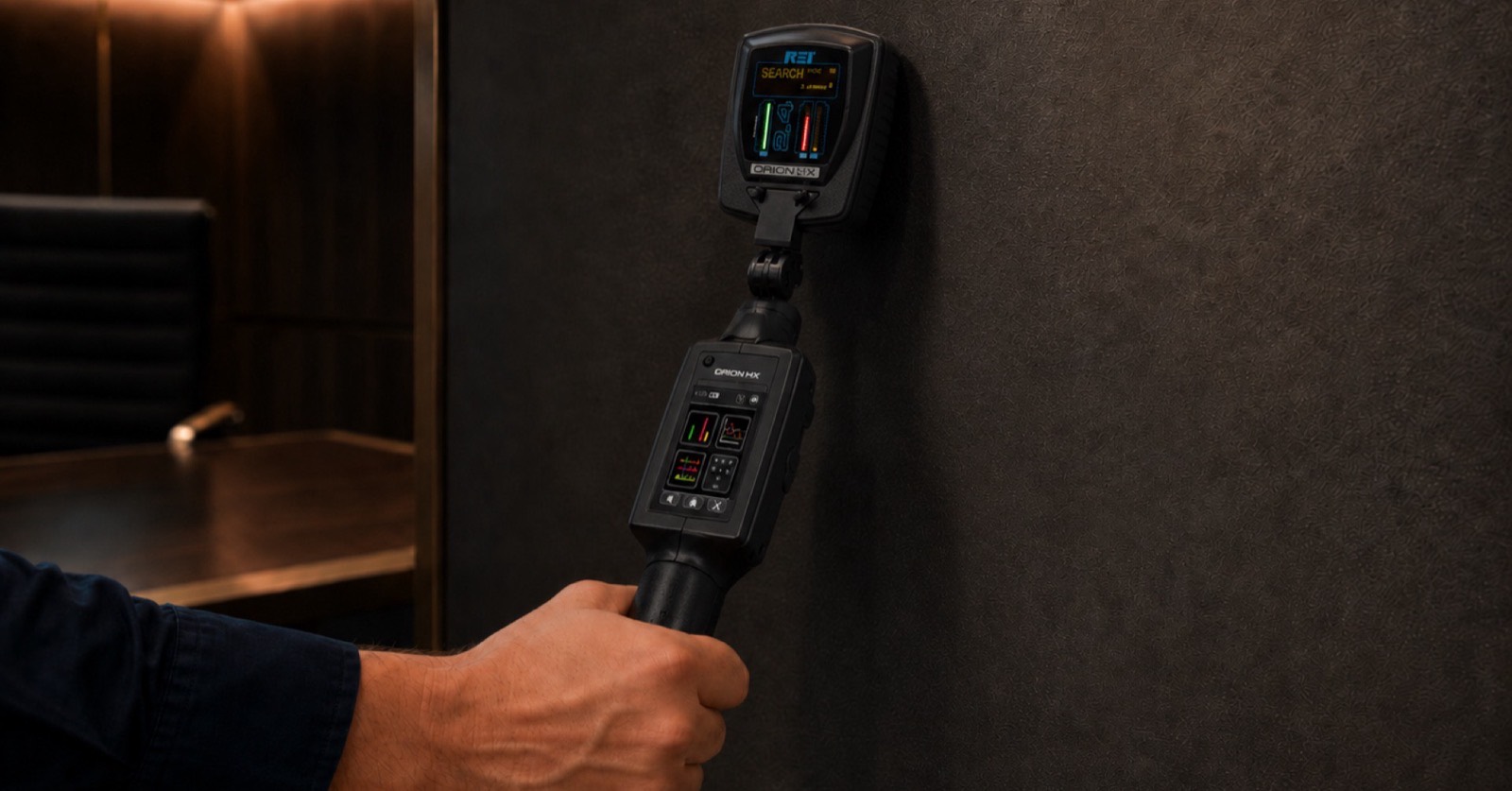
Equipment that does not transmit
Not every device transmits. A recorder that stores locally sends no radio signal. It is found through thorough physical inspection, semiconductor detection that recognises switched-off electronics, and thermal cameras that reveal the residual heat of a concealed device or power supply.
Fixed infrastructure and cabling
We also examine the fixed infrastructure: telephone, data and power lines with a cable measurement that reveals breaks and branches, lens detection for wired and wireless cameras and a videoscope for spaces behind walls, panelling and in ceilings and installations.
Depending on the context, we may deploy:
- Broadband receivers and frequency scanners with a range of antennas and filters.
- Spectrum and vector signal analysis for closer assessment of signals found.
- GSM, Wi-Fi and broadband detection.
- Semiconductor detection (non-linear junction detection) of electronics that do not transmit.
- Thermal cameras for heat traces from active components.
- Lens detection of concealed cameras.
- Cable measurement (time/frequency domain reflectometry) for copper telephone and data lines.
- Videoscope for spaces that are hard to reach.
- Multimeter for measurements on power supplies and components.
- Wall scanner to detect objects built into (stud) walls and ceilings.
Absolute certainty does not exist, but a methodically executed sweep maps technical eavesdropping risks to a large extent. We systematically examine the radio-frequency spectrum, the cabling and the room, according to detection criteria established in advance and with transparent reporting of scope, findings and residual risks.
Sources
- Ministry of Justice and Security. Algemene Beveiligingseisen voor Rijksoverheidsopdrachten 2026 (ABRO). The Hague, 2026.
- “Bugging devices found in Polish government meeting room.” NBC News, May 2024. Example of equipment found in a meeting room during a routine check.
- “‘American friends’ spied on Julian Assange in Ecuadorian Embassy, court hears.” Computer Weekly, September 2020. Example of microphones concealed in the fittings of a room.
- “EU delegations’ offices bugged in Brussels HQ.” Statewatch, March 2003. Example of devices in telephony infrastructure that went unnoticed for a long time.
More documented examples, with a source for each case, are on Publicly known cases.
Frequently asked questions
- What is the difference between an EVO and a TSCM sweep?
-
EVO is the Dutch term, used among others by the Dutch government for an investigation into the potential presence of unwanted equipment in a secured room. TSCM is the international abbreviation for technical surveillance countermeasures. The difference lies mainly in the origin: the EVO grew out of (state) counter-espionage, whereas TSCM is broader and is applied in law enforcement and private organisations.
On this site we use both terms interchangeably because our examination capabilities serve both audiences.
- Does the room have to be out of use during the survey?
-
That depends on what you want. A survey in which furniture may be opened and the room is free for half a day goes further than one that has to stay unnoticed during normal operations. Both are possible; the choice shapes the scope and belongs in the agreement beforehand.
- Can the survey stay unnoticed by staff?
-
Yes. We work outside office hours and without announcement where required. That does limit what can be opened and how much time is available, so it is a trade-off that belongs in the preparation rather than halfway through.
- What happens if something is found?
-
That is agreed in advance. Removing a find immediately can destroy traces you may need later, for instance in a criminal complaint or civil proceedings. Leaving it in place is also an option, provided you know what is still discussed in that room.
Read more about our EVO/TSCM sweeps.