Publicly known cases
Technical surveillance mostly stays out of sight and rarely becomes public. Even so, there are well-documented cases in which concealed eavesdropping and observation devices, technical interception or covert access were established.
The cases that follow come from government, diplomacy and business, and are publicly documented. Not every case concerns a physically recovered eavesdropping device; some concern interception, technical implants or other capabilities that became known through official sources, court proceedings or investigative journalism. Together they show that sensitive information can be compromised through more channels than the digital network alone.
Why so few cases become public
The discovery of concealed eavesdropping or observation devices is rarely made public. Operational interests, ongoing investigations, legal consequences and reputational damage can all play a part. Precisely in environments where confidentiality is taken for granted, disclosure can be sensitive. A compromised boardroom, embassy or secured workplace affects not only the information that may have been intercepted but also confidence in the security itself. The examples below therefore do not form a representative cross-section of technical surveillance. They show what is publicly known.
Documented cases
-
2026
Private office, Geneva
During a routine security inspection of the home of Klaus Schwab, founder of the World Economic Forum, a concealed listening device was found in his home office, Bloomberg reported.
“WEF Founder Schwab Says He Found Secret Listening Device in Home,” Bloomberg, July 2026. -
2024
Polish cabinet meeting room
Ahead of a meeting of the Polish council of ministers in Katowice, security services found eavesdropping equipment in the meeting room. The discovery followed a routine security check.
“Bugging devices found in Polish government meeting room,” NBC News, May 2024. -
2018
OPCW, The Hague
Dutch services disrupted a Russian operation against the Organisation for the Prohibition of Chemical Weapons (OPCW). Equipment with Wi-Fi antennas, a laptop and mobile connectivity was set up in a parked car to gain access to the organisation’s wireless network.
“Russian cyber operation disrupted,” Netherlands Ministry of Defence, October 2018. -
2017–2018
Ecuadorian embassy, London
Proceedings concerning Julian Assange described how cameras and microphones were deployed in and around the embassy. One microphone was said to have been built into the base of a fire extinguisher. Measures were also described that were intended to enable observation through the windows.
“‘American friends’ spied on Julian Assange in Ecuadorian Embassy, court hears,” Computer Weekly, September 2020. -
2016–2017
Uber
During the Uber–Waymo lawsuit a letter became public in which a former Uber manager described how an internal intelligence team gathered information about competitors. Covert observation, digital access and the recording of conversations were among the methods named.
“Unsealed letter in Uber-Waymo case details how Uber employees allegedly stole trade secrets,” CNBC, December 2017. -
2013
Barclays, London
An attacker posing as an IT engineer gained physical access to a Barclays branch and connected a technical device to an office computer. A KVM switch and a mobile connection then allowed remote access to the system. Around £1.25 million was taken.
“‘Bogus IT guys’ slurp £1.3m from Barclays: Cybercops cuff 8 blokes,” The Register, September 2013. -
2013
NSA ANT catalogue
A leaked NSA catalogue described a range of specialised technical implants for monitor, keyboard, USB and network interfaces, among others. Some of them needed no active transmitter of their own but could be illuminated from outside and return information through the reflected signal.
“Catalog Reveals NSA Has Back Doors for Numerous Devices,” Der Spiegel, 29 December 2013. -
2012–2017
African Union
According to reporting, large volumes of network data were sent at night to servers in Shanghai from the Chinese-built headquarters of the African Union over a period of several years. Technical examination was also said to have found microphones in desks and walls.
“African Union Bugged by China: Cyber Espionage as Evidence of Strategic Shifts,” Council on Foreign Relations, March 2018. -
2003
Justus Lipsius building, Brussels
In what was then the EU Council building, technical devices capable of intercepting conversations were found in the telephony infrastructure of several delegations. According to reporting the devices were discreetly integrated and may have been active for a considerable time before they were discovered.
“EU delegations’ offices bugged in Brussels HQ,” Statewatch, March 2003.
Deep dive: the NSA ANT catalogue
RAGEMASTER, SURLYSPAWN, HOWLERMONKEY, ANGRYNEIGHBOR. Names that would not look out of place on the poster for a metal festival such as Wacken Open Air. TOP SECRET//COMINT//REL TO USA, FVEY sounds rather less carefree.
They are names from a catalogue of the National Security Agency (NSA). Forty-nine pages of product sheets, laid out like an order guide for office supplies. A photograph of the item, with a description of what it can do. The price alongside it, $30 apiece for instance. As if you were ordering stationery. The TOP SECRET classification would not have lapsed until 2032, had Der Spiegel not published it in 2013.
The catalogue dated from 2008–2009 and came from the Advanced Network Technology (ANT) division within the NSA’s Tailored Access Operations unit. Security researcher Jacob Appelbaum presented it to a hall full of hackers at the Chaos Communication Congress. Nothing has ever become known about the source, though it is widely doubted that this formed part of what Edward Snowden released. The NSA has never elaborated (naturally).
Thirty dollars for an advanced attack model
Take RAGEMASTER. The leaked NSA ANT catalogue describes an RF retroreflector that could be concealed in the ferrite core of a VGA cable: the thickened section of the cable a user rarely gives a second thought. The implant tapped the red video signal. When illuminated from outside with a radio signal, that signal was modulated with the image information and re-radiated. At the receiving end, a device such as NIGHTWATCH could reconstruct the image on the screen from it.
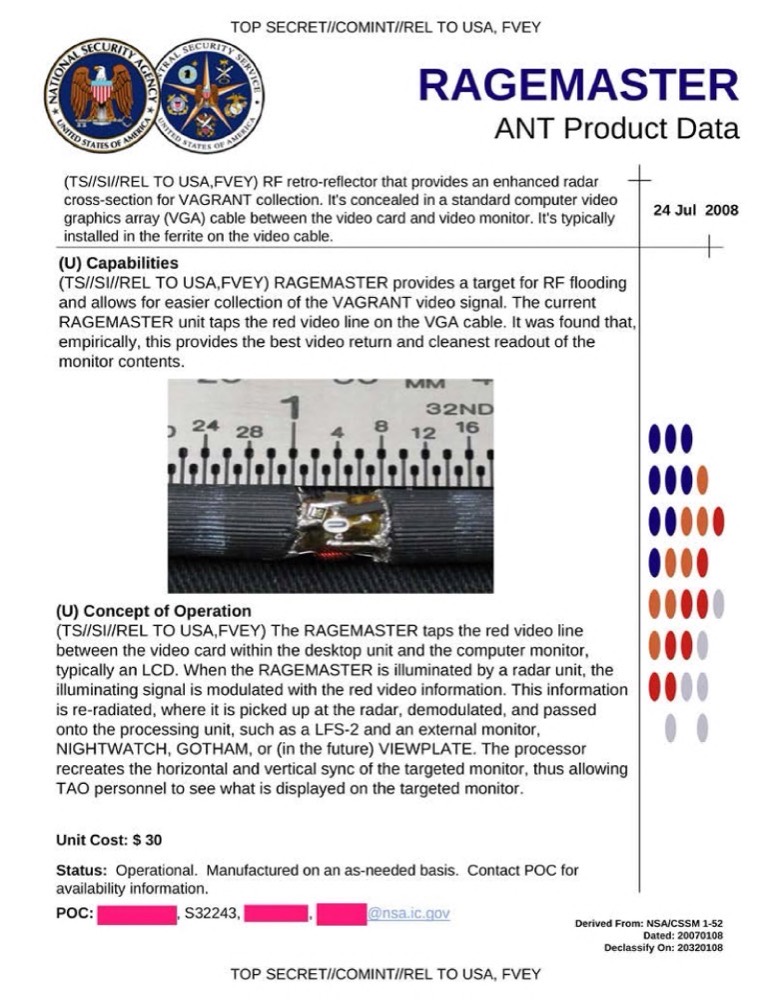
Capabilities for thirty dollars
That figure is interesting because it corrects a misconception. The technical component itself need not be the expensive part of a targeted operation. The difficulty can lie instead in the operational opportunity to reach the right cable, computer or room unseen.
RAGEMASTER did not stand alone, either. SURLYSPAWN applied the same principle to keyboard data and, according to the catalogue, worked with USB and PS/2 keyboards. No software had to run on the target computer; the system only had to be physically touched once for the implant to be placed. SURLYSPAWN also cost thirty dollars.
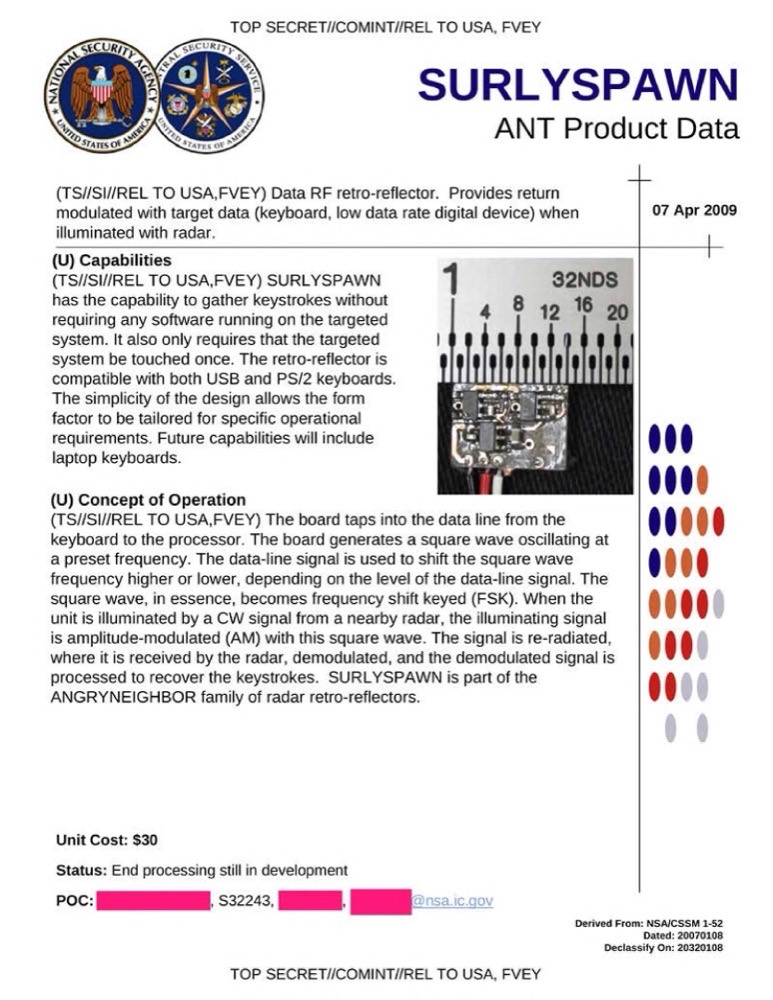
LOUDAUTO used the principle for conversations in a room. A microphone converted sound into an electrical signal with which the reflected radio wave was modulated. The design was not entirely passive but drew very little power. The price was again thirty dollars.
TAWDRYYARD likewise cost thirty dollars but served a different purpose. It was a small RF beacon used to locate and identify previously placed RAGEMASTER units. This device, too, became visible to the receiving system only when illuminated with the right radio signal.
How does a retroreflector work?
The essential difference from an ordinary concealed transmitter is that the information does not have to be transmitted continuously and independently. An external source illuminates the target with a radio signal. The implant alters the properties of the reflected wave according to the information to be intercepted, such as keyboard data, image information or sound. The receiver then analyses that modulated reflection. This is why the intuition “if nothing transmits, I cannot receive anything” falls short here. The signal of interest arises precisely when the external source and the implant are active together. After the catalogue was published, researchers also reproduced the principle experimentally using commonly available software-defined radios (SDRs). That has an important consequence for technical security examination: a spectrum measurement at one arbitrary moment is not the same as an examination for every conceivable technical implant.
The equipment across the street
For illuminating those devices the catalogue describes, among other things, the CTX4000, a portable continuous-wave radar for collecting what it calls off-net information. The system worked between 1 and 2 GHz and delivered up to 2 watts internally; with external amplification the specification listed power up to 1 kilowatt. In 2008 the system was, according to the catalogue, approaching the end of its service life. The planned successor was PHOTOANGLO, a joint NSA and GCHQ project. It was to fit into a slim briefcase, weigh less than ten pounds and initially work between 1 and 2 GHz. At that point the catalogue still described it as a system under development. The briefcase is the most interesting detail here. This is not necessarily a van with antennas on the roof. The equipment is designed for targeted deployment close to the target.
From listening to access
Other parts of the ANT catalogue show that physical proximity was used for more than eavesdropping. NIGHTSTAND was an active 802.11 system for delivering exploits into wireless networks remotely. According to the catalogue, successful attacks had been carried out from distances of up to eight miles under ideal conditions. SPARROW II was a compact WLAN survey system set up for deployment from a UAV, among other platforms.
More interesting still for the notion of an air gap is the COTTONMOUTH family. Here network functionality was concealed in components that could look like ordinary USB or network connectors. COTTONMOUTH-I was to provide a wireless bridge into a target network and was explicitly described as a means of air-gap bridging. COTTONMOUTH-II hid part of the technology in a dual USB connector; COTTONMOUTH-III used a combined RJ45/USB construction and an RF transceiver.
That does not make the physical separation disappear as such. But a hardware implant can undermine precisely the security assumption an air gap rests on: that no uncontrolled communication path exists between the two sides. The price here was of an entirely different order. The catalogue listed just over one million dollars for fifty COTTONMOUTH-I units and around 1.25 million dollars for fifty COTTONMOUTH-III units.
What this catalogue does and does not prove
Some context: the ANT catalogue describes technology from roughly 2008 and 2009 and became public at the end of 2013. It therefore does not tell us which devices are operationally deployed in 2026, by whom, or against which targets. No reliable conclusion on that can be drawn from this source. What the catalogue does show is a technical principle: a competent adversary need not depend on a continuously active radio transmitter but can operate very quietly.
The applications were targeted. Placing an implant requires access to a target, directly or through some other form of physical or logistical access. That does not make such close-access devices a realistic default scenario for every office. Relevance depends on the threat profile. At the same time, the underlying technique is no longer the exclusive domain of intelligence services. After the catalogue was published, researchers reproduced parts of the concept with open hardware and commonly available software-defined radio. An academic study from 2018, for instance, demonstrated an RF retroreflector attack with commercial equipment and recovered keyboard data in a laboratory set-up.
That does not prove that organised crime or other actors actually deploy this technique operationally. It does show that the knowledge barrier has come down: a principle set out in a classified catalogue from 2009 could, a few years later, be rebuilt and studied by independent researchers. The technique is therefore no longer reserved for actors with high-end R&D of their own.
Sources for the deep dive
- National Security Agency. NSA’s Spy Catalogue (ANT Product Data). Document collection of the American Civil Liberties Union. The primary source for the product sheets, unit costs and specifications cited above.
- “Catalog Reveals NSA Has Back Doors for Numerous Devices.” Der Spiegel, 29 December 2013. The original publication of the catalogue.
- “Interactive Graphic: The NSA’s Spy Catalog.” Der Spiegel, 30 December 2013. The individual product sheets.
- Schneier, Bruce. “Exploit of the Day.” Schneier on Security, 2013–2014. Technical discussion of each catalogue item.
- Schneier, Bruce. “Building Retro Reflectors.” Schneier on Security, June 2014.
- Wakabayashi, Satohiro, Seita Maruyama, Tatsuya Mori, Shigeki Goto, Masahiro Kinugawa and Yu-ichi Hayashi. “A Feasibility Study of Radio-frequency Retroreflector Attack.” 12th USENIX Workshop on Offensive Technologies (WOOT ’18), August 2018. Reproduction of the principle with commercially available equipment.
What these cases show
- How representative is this list?
-
Not at all, or only to a very limited extent. The list contains cases that became public through official announcements, court proceedings, investigative journalism or other public sources. The great majority of incidents are handled internally, stay secret, are never publicly confirmed or are never discovered at all. Those are absent by definition. The examples above therefore do not reflect reality and say nothing about the actual frequency of technical surveillance. They show only what has demonstrably occurred.
- How long can a device stay unnoticed?
-
There is no general answer. Public cases do show that technical compromise sometimes comes to light only after a concrete indication, a deliberate examination or a chance discovery. A well-placed device need not behave continuously or conspicuously.
- Can I determine my own risk from this?
-
No. The examples show which forms of attack are technically possible and which capabilities have been publicly documented. For a usable assessment of your own situation, the threat profile has to be established first: which information requires protection, who realistically has an interest in it, which capabilities that party can command and which physical or technical access is feasible. That threat picture then determines which examination methods, depth and scope are meaningful.
Read more about our EVO/TSCM sweeps.